SHORT ANSWER
Patio door repair depends on the type of door. Sliders and multi-slide systems wear at the rollers, tracks and sill drainage, so repairs focus on leveling panels and clearing water paths. Hinged French doors sag at the hinges and stop meeting their strike, so the fix is hinge adjustment, shims and lock alignment.
Which patio door do you have?
"Patio door" covers at least four different machines. A two-panel slider, a wall of stacking glass, a pocketing system and a pair of French doors all lead outside, but they wear out in different places. Find yours below, and you'll know where to look.
XO / OX
Two-panel slider
How to spot it: One panel slides, one stays put, and the screen rides on the outside.
What usually fails: Drags as rollers wear, the latch misses once the panel sags, water sits in the sill when weep holes clog.
OXO / OXXO
Three or four panel slider
How to spot it: More glass, often two panels that slide toward the middle and meet.
What usually fails: Everything a two-panel slider does, on every moving panel, plus panels that don't meet evenly where they lock together.
Stacker
Stacking multi-slide
How to spot it: Three or more panels on parallel tracks that slide behind each other to one or both ends.
What usually fails: Each panel has its own rollers to keep level, the overlaps between panels drift out of line, and the wide sill has to drain well.
Pocket
Pocketing multi-slide
How to spot it: The panels disappear into a pocket built into the wall, so the whole opening clears.
What usually fails: Debris collects in the pocket, the end panel drags as it goes in, and the pocket needs its own drainage.
Swing
Hinged French door
How to spot it: Panels swing on hinges, usually one active panel with the handle and one passive panel bolted at top and bottom.
What usually fails: Sags and rubs at the top corner, the latch stops meeting the strike, and multipoint locks and weatherstrip wear out.
If you're not sure, open the door and watch the bottom edge. Wheels in a track mean a slider of some kind. Hinges on the side of the frame mean a swinging door, and the repairs happen at the hinges and the strike instead.
On sliders, the bottom of the panel does the work
Two, three and four panel sliders all fail the same way, just on more panels. Every moving panel rides on rollers in its bottom rail, and when those wear, the panel sinks, drags and stops lining up with its lock. A stiff panel is usually a panel out of alignment, so that's the first thing to check.
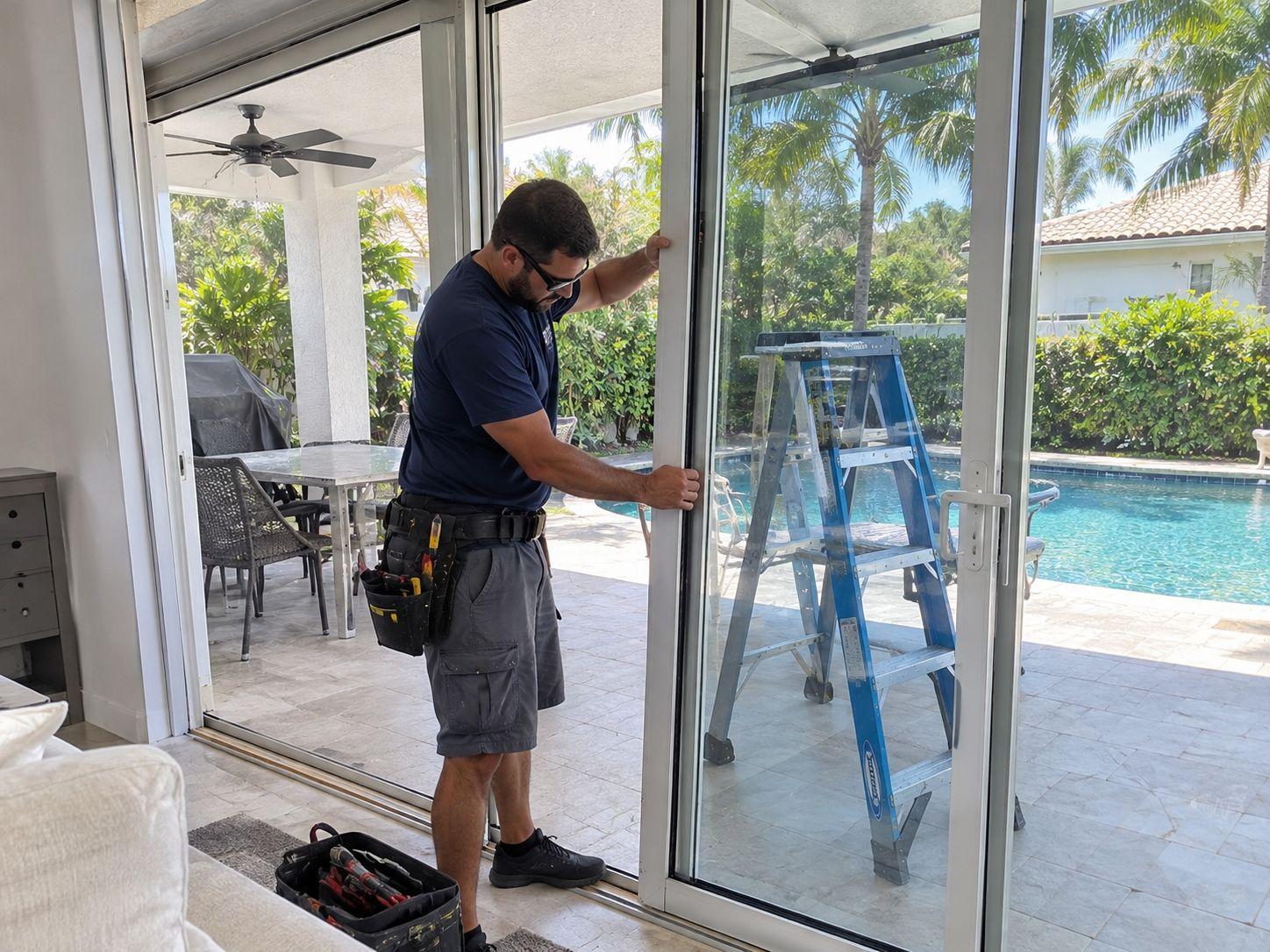
On an OXXO door, the two center panels have to meet in the middle where they lock together. If one has dropped further than the other, the lock won't engage and the meeting edge gaps at the top. Leveling both panels to each other, not just to the frame, is what fixes it. Worn wheels themselves get replaced and leveled, and a rough or dented rail is a job for track repair.
Multi-slide and pocketing doors are bigger versions of the same idea
Stacking and pocketing systems put three, four or more panels on parallel tracks. Each panel carries its own rollers, so each needs its own height adjustment. The process goes like this: lift the panel with a block of wood to take the weight off, open the adjustment cover, and set the height with a hex wrench until the gap along the frame is even.
The sill is the weak point. A multi-slide sill is wide and has to drain several tracks at once. A well-built sill slopes so water runs off through the weep system, with a sill pan under it in every installation. Pocketing doors add a hidden problem, because whatever blows into the pocket stays there. Manufacturer instructions call for the pocket itself to be panned with an end dam on every side, which tells you how seriously water in that cavity is taken.
If a multi-slide door leaks at the sill even with clean weep holes, the cause may be the installation under it, and that needs someone to look in person.
Hinged French doors fail at the hinges and the strike
A French door that rubs at the top corner, or won't latch without a shove, has usually sagged on its hinges. There are two kinds of fix. Adjustable hinges have screws you turn a quarter turn at a time to shift the panel. Standard hinges get thin shims behind the hinge plate to push the door back into square.
The latch side follows. When the door drops, the latch or the hooks of a multipoint lock miss the strike plate on the frame. The fix is to loosen the strike screws, slide the plate to meet the latch, and shim behind it if needed. Many French doors also have a passive panel held shut by bolts at the top and bottom, and those bolts stop reaching their holes once the doors sag.
Multipoint locks need cleaning on the coast. Blow the sand and salt out of the mechanism with compressed air, then use a waterproof lubricant.
Glass is the same problem on every type
Fog between the panes means the sealed glass unit has failed, whatever the door style. A cracked pane needs safety glass made to size. Federal rules treat glass in patio-type sliding doors as Category II safety glazing, and glass in other doors moves into that same category once any single piece passes 9 square feet, which is easy to reach on a big French door. That means replacement glass for a large French door lite is held to the same standard as a slider's.
Brand, model and the hunt for parts
On an older patio door, the repair is often the easy part. Finding the part is the job.
Some older or discontinued sliding door systems can be difficult to work on, especially when manufacturers no longer produce replacement components. I've found that older impact door models and certain discontinued aluminum door brands can sometimes require extra effort to source the correct rollers, handles, or locking mechanisms.
The biggest challenge isn't always the brand itself, but identifying the exact model and finding compatible replacement parts.
Florida homes are full of impact doors from makers whose older models are no longer supported, and our crews run into them all over the state. So a patio door call starts with identification: the door type, the brand and model if a label survives, and measurements of the worn part if it doesn't. Then we work the door through its full movement, check the gaps around every panel, and look at the sill drainage. You'll hear which part is worn, whether it's adjustable or needs replacing, and whether parts for that door are still made.
Weather in the frame, not just the panels
Patio doors keep weather out with weatherstrip, sweeps and the way panels overlap. When a slider's panel is set too high or too low, those seals stop meeting and air and water come through. Wet floors after a storm usually start at the sill, though, so read about weep holes on our track repair page before blaming the frame.
When the frame itself is rotted, corroded or bent, repair may not be worth it. Our sliding glass door replacement page covers that decision and Florida's permit rules. For a symptom-by-symptom approach to any slider, see sliding glass door repair.
FAQ
Patio door questions by door type
What kind of patio door do I have?
Watch how it opens. Panels that slide on a bottom track are a slider. Panels that stack behind each other or vanish into the wall are a multi-slide. Panels on side hinges are a French or swinging door.
Why is my French patio door rubbing at the top?
It has sagged on its hinges, so the top corner on the latch side drops into the frame. Adjustable hinges have screws you turn a quarter turn at a time. Standard hinges are corrected with thin shims behind the hinge plate.
Why won't my French door latch without pushing hard?
The latch or the hooks of its multipoint lock are missing the strike plate, usually because the door has sagged. Fix the sag first, then loosen the strike screws and slide the strike to meet the latch, with a shim behind it if needed.
How do you adjust the panels on a multi-slide door?
One panel at a time. Each has its own rollers with a height adjuster, often a hex screw under a cover near the bottom. Take the weight off with a block, adjust, and check that the gap along the frame and the next panel is even.
Why do the middle panels of my four-panel slider not meet?
One center panel has dropped more than the other, so the edges where they lock together don't line up. Both panels need leveling to each other, not just to the frame, and worn rollers on either one need replacing.
Why does my multi-slide door leak at the sill?
Start with the weep holes, since a wide multi-slide sill drains several tracks. If it still leaks with clean weeps, the sill pan or installation underneath may be the problem, which needs someone to inspect it on site.
What is the passive panel on a French door?
It's the panel without the main handle, held closed by bolts that shoot into the head of the frame and the sill. The active panel latches against it. When the doors sag, those bolts often stop reaching their holes.
Do French doors need safety glass?
Glass in doors falls under federal safety glazing rules. Glass in a door other than a slider moves to the stricter Category II once any single piece is over 9 square feet, which large French door lites can reach.
How do I keep sand out of a multipoint lock?
Blow the mechanism out with compressed air, then lubricate it with a waterproof lubricant, the right choice near the coast. A lock that grinds or needs force to turn usually has grit in it.
Can a patio door be repaired if the brand is out of business?
Often, yes. Rollers, handles and weatherstrip can usually be matched by measuring the old parts. The harder cases are custom lock bodies and special extrusions, where a near match may need some fitting or a different approach.
Not sure what kind of patio door you have? Send us a photo from inside with the door half open, and we'll tell you what it is and what usually wears on it.