SHORT ANSWER
Sliding door roller replacement means swapping the small wheel assemblies in the bottom of the glass panel. You need it when the door drags or grinds and raising the rollers with their adjustment screws doesn't help. The panel comes out, the old rollers are matched by size and mounting, and new ones go in and get leveled.
Try the adjustment screw before you buy anything
A dragging door doesn't always mean a dead roller. Most patio sliders let you raise or lower each roller with a screw, and a panel that has simply settled low will drag exactly like one with a worn wheel. Five minutes with a screwdriver tells you which one you have.
Look at the two bottom corners of the moving panel. The adjustment holes sit there, either on the inside face or on the vertical edge, and they're often hidden under small plastic caps you can pry out.
- Open the door about a foot so you can reach both holes.
- Lift the panel slightly with one hand to take its weight off the roller.
- Turn the screw a quarter turn by hand. Don't use a drill: it strips the screw and can crack the housing.
- Close the door and check the gap between panel and frame. It should be even from top to bottom.
- Repeat on whichever side needs it, a quarter turn at a time.
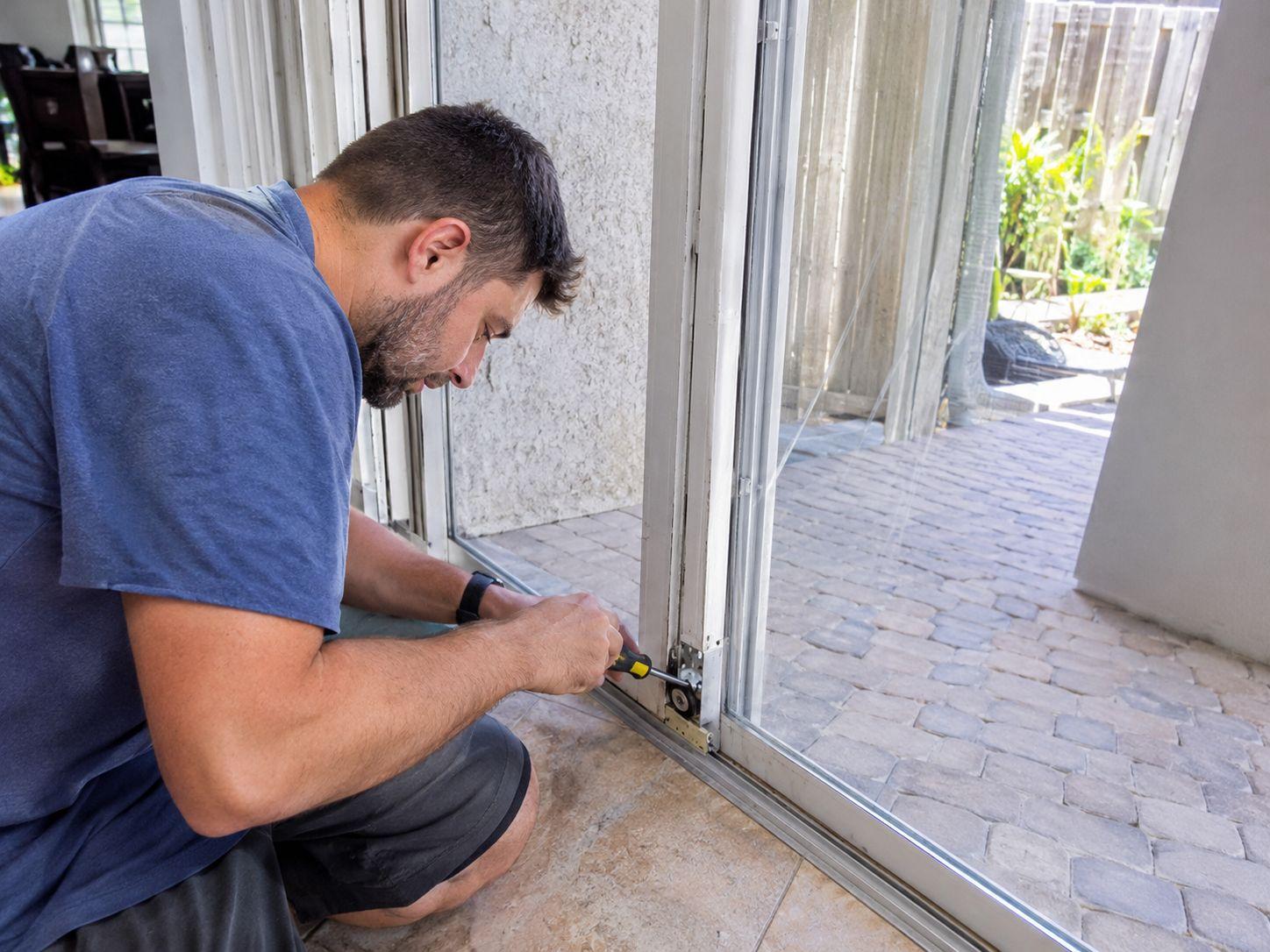
Don't assume clockwise raises the door. Depending on how the screw is mounted, some rollers go up when turned clockwise and others go down. Make a small turn and watch what happens.
Going too high causes its own trouble, because a panel set too high can leak air and water. The target is just enough lift to clear the track and keep the weatherstrip tucked out of sight.
Signs the roller itself is finished
If adjusting doesn't fix the slide, the wheel is the problem. Any of these means replacement:
- The screw turns but the panel doesn't move, which usually means the housing is broken inside
- A wheel that is cracked, chipped, or worn flat on one side so it thumps as it rolls
- A wheel that won't spin by hand once the panel is out
- Rust on the axle or housing, or orange streaks along the track
- The door still grinds after the track has been vacuumed clean
Grinding can come from the rail too. If the track has dents or a worn ridge, new rollers will ride badly and wear out early, so it's worth reading about track repair before you order parts.
Which roller do you have?
There's no universal sliding door roller. Two rollers can look identical on a parts site and still differ slightly in the housing or the wheel.
Another common mistake is purchasing replacement rollers based only on appearance rather than checking the exact measurements and specifications. Even small differences can affect how the door operates.
If you're buying the part yourself, measure these eight things first.
MEASURING GUIDE
- A
- Wheel diameter. Edge to edge through the center. Common sizes run from 1 in. to about 1-11/16 in.
- B
- Housing length. End to end of the metal or plastic body, not counting tabs.
- C
- Housing height. Bottom to top with the wheel screwed all the way up.
- D
- Adjustment screw. Note where it sits: end, side or top. The new roller needs its screw in the same spot, or you can't reach it through the panel.
- E
- Mounting. Tabs that hook into slots, a screw hole, or a plain back held by the rail.
- F
- Housing width. Side to side. It has to fit the channel in the bottom of your panel.
- G
- Wheel width. Measure the tread of the wheel only, not the axle or hub.
- H
- Edge profile. Flat, concave or center groove. It must match the shape of your track.
Write this down before you order
All eight measurements above, wheel material (nylon, steel or stainless), single or tandem, and the door brand if a label is visible on the frame or in the corner of the glass. Measure in 1/16 in. steps. A worn wheel reads smaller than a new one, so compare the housing first.
A label helps if you can find one. Some makers etch their name into a corner of the glass or stick a label on the frame edge. With a brand and a model, the parts catalog does most of the work.
Older doors are where it gets hard. On older impact models, and on aluminum doors from brands that no longer exist, we sometimes have to dig to find the right roller. Our patio door page goes into why identifying the exact model matters more than the brand. It comes up a lot in older housing like Hialeah's, where more than three quarters of homes were built before 1990.
Nylon, steel or stainless
The wheel material matters more in South Florida than almost anywhere else. Here's how the common types compare.
| Wheel | Near salt water | Watch out for |
|---|---|---|
| Nylon or plastic | Won't rust | UV and heat break plastic down over time, and a soft wheel can flatten under a heavy panel |
| Steel | Rusts if the plating wears through | A rusted axle or bearing seizes, and then the wheel skids instead of rolling |
| Stainless steel | The best choice for salt exposure | Costs more, and the housing has to fit your panel just like any other roller |
Most of these come with ball bearings in the hub, and on the rollers we pull out, the bearing is often what failed first. No option is perfect: metal hardware corrodes eventually, and plastic breaks down in sun and heat. Inland, a good nylon or steel roller is usually fine. Within sight of the water, we lean toward stainless when the right size exists for your door.
Why salt air is so rough on rollers
It's chemistry, and it gets worse wherever two metals touch. When two different metals sit together with salt water between them, one corrodes in place of the other. Aluminum is the metal that gives way.
A sliding door puts a steel roller inside an aluminum panel, riding on an aluminum track, in air full of salt. Add the damp that sits in a sill track for days after rain, and you have the setup that pits housings and locks up bearings. Plan on hardware maintenance at least twice a year, and monthly in coastal areas.
Heavy impact doors need rollers rated for the weight
Impact-rated panels use laminated glass and heavier frames, and the rollers carry all of it. The industry roller standard tests roller assemblies at the weight the manufacturer rates them for, cycling them under load 10,000 times. Ratings span from 75 pounds to more than 600 pounds per assembly.
A light-duty roller under a heavy panel is carrying more than it was ever tested for. Match the rating as well as the size, and don't take a listing's word for a rating its maker doesn't publish.
Before you pull the panel out
If the adjustment fixed it, you're done. If you need new rollers, read this first.
The biggest mistake I see is trying to force a sliding glass door open or attempting to adjust the rollers without understanding how the door is constructed. Sliding doors are heavy, and improper handling can damage the track, rollers, or frame.
On most doors the glass panel has to come out of the frame to reach the rollers, and that's a two-person lift at minimum. Some aluminum doors let you change rollers without pulling the panel, by taking off the side pieces of the frame. Others don't. Either way, set the new rollers to their lowest position before installing, adjust both sides equally afterward, and never hit aluminum with a metal hammer face, since it dents easily.
Call us if the panel is heavy or impact-rated, if the screws are rusted in place, or if the correct roller for your door isn't made anymore.
What a roller swap looks like on-site
We check the track first, because new rollers on a bad rail is money wasted. Then the panel comes up and out, the old rollers come out of the bottom rail, and we measure them against what we carry. The new ones go in at their lowest setting, the panel goes back on the track, and we adjust until the gaps are even and the latch lines up with its keeper.
That last step matters. Once a panel's height changes, the latch keeper often needs moving too, which is why a latch that stops catching often gets sorted out during a roller job.
Related roller problems
The screen panel outside your glass door rides on its own, much smaller rollers. When the screen drags or jumps out, it's a different part and a quicker fix, covered on our screen door repair page.
Mirrored closet doors are the indoor cousin. Many of them roll on bottom rollers too, but the top of the door has to sit high enough in its channel to stay put, so a closet door that keeps jumping out is usually a height problem before it's a wheel problem.
When the rollers are fine but the bottom rail of the panel itself is corroded or split, there's nothing solid left to hold a roller. That's one of the few roller-related problems where a new door is the honest answer. For anything else your door is doing, start with our guide to sliding glass door repair.
FAQ
Roller questions, from adjustment screws to stainless
Can I replace sliding glass door rollers myself?
Often, yes, if you have a helper and the right part. The glass panel usually has to be lifted out of the frame, and that's dangerous to do alone. Heavy impact panels are best left to a pro.
How do I know if my sliding door rollers are bad?
Raise the rollers first. If the door still drags or grinds, the wheels are likely cracked, worn flat or seized. Once the panel is out, spin each wheel by hand: rough spots, wobble or rust on the axle mean it's done.
Which way do I turn the screw to raise my sliding door?
It depends on the roller. Some rollers rise when turned clockwise and others drop. Lift the panel slightly, turn a quarter turn, and check whether the gap at the top got smaller or bigger.
Where is the roller adjustment screw on a sliding glass door?
At the two bottom corners of the moving panel, either on the inside face or on the vertical edge. Many doors hide the holes under small plastic caps that pry out with a flat screwdriver.
Are sliding door rollers universal?
No. Rollers differ in wheel diameter, wheel width, edge shape, housing size, mounting style and where the adjustment screw sits. Measure the old one, or take it with you to a parts counter, before buying a replacement.
What is the difference between single and tandem rollers?
A single roller has one wheel in its housing. A tandem has two wheels in line, which spreads a heavy panel's weight over more contact points. Replace like with like, because the housing sizes differ.
Are stainless steel rollers worth it near the beach?
Usually, yes. Stainless resists salt corrosion far better than plated steel, which starts to rust once its coating wears through. The catch is fit: stainless has to be made in the exact size your panel takes.
Can I replace just the wheel instead of the whole roller?
Sometimes. A few roller assemblies take replacement wheels on their own, but many wheels are riveted into the housing. For those, and for any housing with rust or a stripped adjustment screw, replace the whole assembly.
Do I have to take the door off to replace the rollers?
On most doors, yes: the panel is lifted up and swung out at the bottom. Some aluminum doors allow a roller swap by removing the vertical side pieces of the panel instead, but that depends on how the door was built.
Should I oil my sliding door rollers?
Follow your door maker's care sheet, since makers disagree. Some call for light oil where the shaft passes through the wheel, while others use sealed bearings meant to run dry. Never pack the track with grease.
How many rollers does a sliding glass door have?
Two per moving panel, one at each bottom corner. A three or four panel door has rollers on every panel that slides. Fixed panels sit on the frame and don't roll.
How much weight can sliding door rollers hold?
It depends on the roller's rating. The industry roller standard tests roller assemblies at their rated load, with ratings running from 75 pounds to over 600 pounds. A heavy impact panel needs rollers rated for it.
Measured your roller and still not sure it's the right one? Send us a photo of it next to a ruler and we'll tell you what we'd use.