SHORT ANSWER
Sliding closet door repair fixes bypass and mirrored doors that fall off the track, scrape the floor, or leave a gap at the wall. These are interior doors that either hang from the top track or roll on a floor track. Most repairs are a height adjustment, a new roller or hanger, or a replacement floor guide.
First, find out if it hangs or rolls
Bedroom closet sliders look simple, but they come in two designs that fail in opposite ways. On a top-hung door, wheels in the header track carry the weight and the floor guide only keeps the doors in line. On a bottom-rolling door, which covers most mirror doors, rollers in a floor track carry the weight and the top track only keeps the panel upright.
That one difference decides where you adjust the door and why it came off. Here's how to tell what you have, along with bifold and pocket doors for comparison.
WHICH CLOSET DOOR?
Bypass (sliding)
- How it moves
- Two panels slide past each other on separate channels. Half the closet is open at a time.
- Where the weight sits
- Top-hung doors carry their weight on hangers in the header track, with a small floor guide to keep them apart. Bottom-rolling doors, which include most mirror doors, sit on rollers in a floor track and only use the top track to stay upright.
- Typical trouble
- Falls out of the track, drops at one end, rubs the other panel, leaves a gap at the wall.
- Where to adjust
- The hanger at the top (top-hung) or the bottom roller nearest the wall (bottom-rolling).
Bifold
- How it moves
- Hinged pairs of panels fold toward the side of the opening on pivots at the top and bottom.
- Where the weight sits
- The panel next to the jamb turns on pivots. The other end rides a guide in a top track.
- Typical trouble
- Drags or binds as it folds, a pivot pops out of its bracket, the doors don't meet in the middle.
- Where to adjust
- The bottom pivot bracket and the top pivot. Which one adjusts the height depends on the brand.
- How it moves
- One panel slides into a cavity inside the wall.
- Where the weight sits
- The door hangs from wheels in a track hidden in the header, with small guides at the floor.
- Typical trouble
- Scrapes the floor, comes off the track inside the wall, won't slide all the way in.
- Where to adjust
- The hangers on top of the door. Getting to them usually means removing the trim along the top of the opening.
How to tell in four steps
- Does the door fold? Then it's a bifold. If not, keep going.
- Does it disappear into the wall? Then it's a pocket door. If not, it's a bypass.
- Slide one bypass panel aside and look at the floor. Wheels sitting in a floor track mean bottom-rolling. Just a small guide block means top-hung.
- Check the top to confirm. Hangers with wheels behind the header trim mean top-hung. Only plastic guides or small guide wheels mean bottom-rolling.
Why a closet door keeps jumping the track
On a bottom-rolling mirror door, the reason we find most often is that the door sits too low. The top of the panel needs to reach far enough up into the top channel to stay captured there. Renin's instructions for its mirror bypass doors call for raising each door at least 3/8 of an inch into the top track channel. A door that has settled below that pops out the first time someone bumps it.
Top-hung doors leave the track for different reasons: a hanger wheel that's cracked or worn, a hanger screw that has loosened so the door tilts, or a floor guide that's missing, so the bottom of the door swings and levers the wheels out. Many top tracks are shaped to hold the wheels in, so a door that keeps falling out of one usually has a problem at the hanger or the guide.
Some doors have anti-jump clips that snap into the track channel once the bottom roller is set to the right height. If they're broken or missing, the door has nothing holding it down.
Adjusting the height
The adjustment is almost always a screw, but where it is depends on the design. On top-hung doors, the hangers on the back of each panel have slotted holes or a cam, and many adjust up or down without taking the screws out. On bottom-rolling mirror doors, each bottom roller has its own adjusting screw, reached from the edge or face of the frame near the floor.
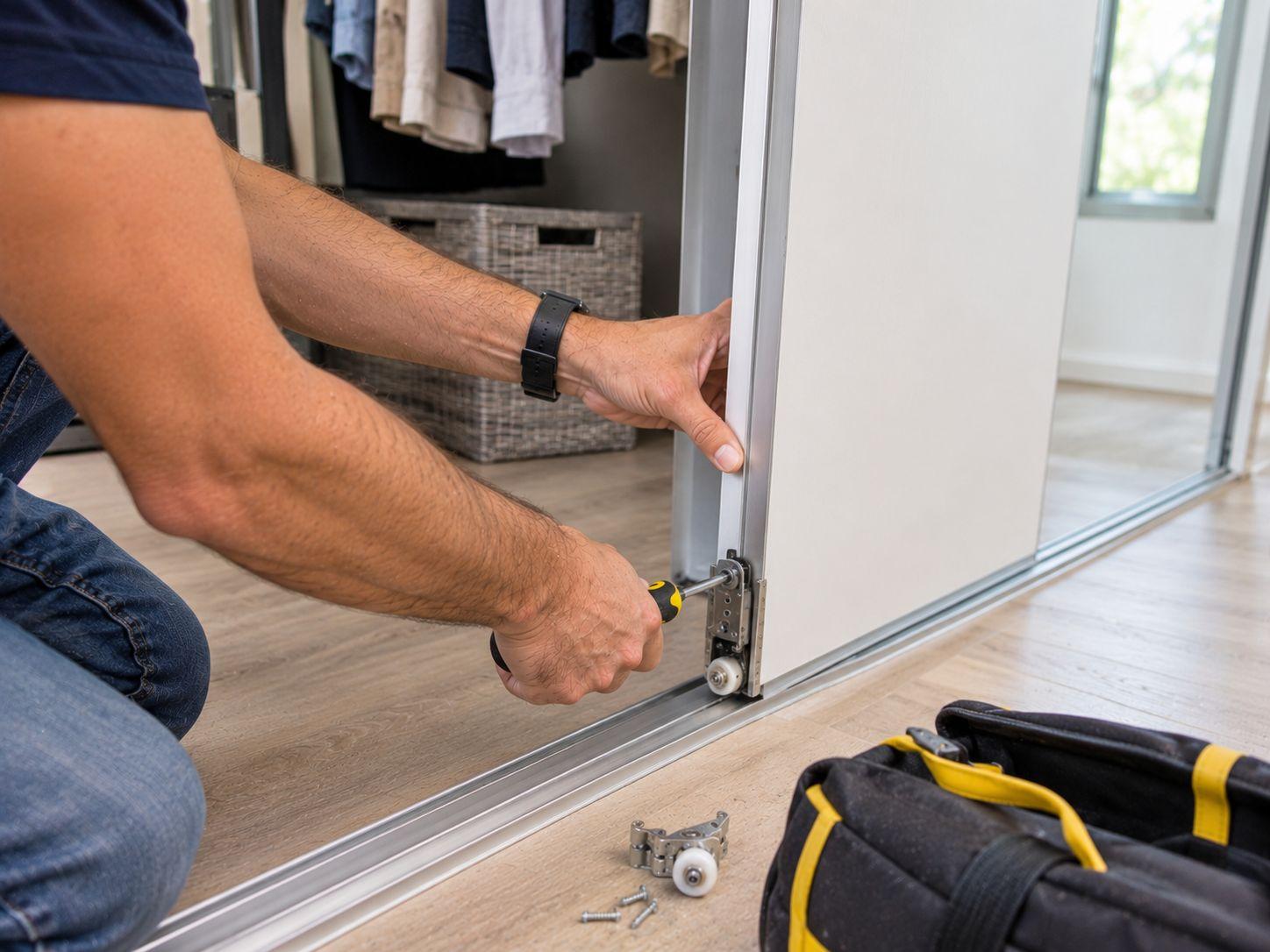
Direction isn't consistent between brands. Renin's instructions say counterclockwise raises its doors, but don't assume that holds for yours. Turn a little, then look at the gap.
A gap between the door edge and the wall means the panel is out of plumb. Turn the screw on the wheel nearest the wall until the panel sits flush against it, raising one side or lowering the other until the edge lines up with the jamb from top to bottom.
Putting a mirror door back on the track
Mirror doors are heavy and awkward, so this is a two-person job. Get the rear door in first. It goes in the back channel at the top and the back groove at the bottom, and the front door goes in front.
The usual method is to tip the bottom of the door out about 15 degrees, lift the top guides into the top track, then swing the bottom in and lower the rollers into the floor track. After that, raise the rollers until the door sits plumb and well up in the top channel.
If the rollers are cracked, flat-spotted or won't spin, replacing them is usually possible. Closet door rollers come in different diameters and edge shapes (flat, concave and convex), and some are brand-specific, so take one off and match it.
Mirrors, safety backing and black edges
Treat a cracked mirror door gently. Most current mirror closet doors are built with a safety backing on the glass to meet the federal safety glazing standard. That backing is what holds broken glass together, so leave it in place, keep the panel upright in the track or lay it flat, and don't pick at loose pieces.
Black spots creeping in from the edges of the mirror are desilvering, not dirt. Moisture gets behind the reflective coating and eats it away, and nothing on the door adjusts it out. Homes near the water see it for a reason: Renin's warranty for its mirror doors excludes black edges, discoloration and slight hardware rusting when the doors are installed within five miles of salt water. Draw that five-mile line along the coast from Miami to Boca Raton and a lot of South Florida closets fall inside it. Once it spreads, the mirror or the panel needs replacing.
Carpet, floor tracks and the closet that never quite closes
Bottom tracks don't belong on top of carpet. Cut the carpet back and fasten the track to the floor, or set thin wood strips under it so it has something solid to sit on. A track that sinks into pad flexes every time the door rolls over it, and the door drifts off line.
This isn't a patio door repair, and that's good news
Closet doors are much lighter than patio sliders, they never see rain or salt directly, and they don't hold out weather. Many repairs come down to a screwdriver, a matched roller and some patience. We're happy to do them, and we'll also tell you when a part is cheap enough that you can handle it yourself. Our Sunrise page covers both doors in a condo, the balcony slider and the mirrored closet.
When the problem is on the other side of the house
Your patio slider uses the same basic idea, rollers on a track, at many times the weight. When it drags, the rollers under the glass panel are the usual cause. When it grinds or floods at the sill, look at the track and weep holes. And for anything else the big door is doing, our sliding glass door repair guide starts with the symptom.
FAQ
Closet door questions
Why does my sliding closet door keep coming off the track?
On mirror doors that roll on the floor, the door usually sits too low to stay captured in the top channel. On top-hung doors, look for a worn hanger wheel, a loose hanger screw, or a missing floor guide letting the bottom swing.
How do I know if my closet door is top-hung or bottom-rolling?
Slide one door aside and look at the floor. If the door's wheels sit in a floor track, it's bottom-rolling. If there's only a small guide block between the doors, the weight hangs from wheels in the top track.
How do you get a mirrored closet door back on the track?
With two people. Tip the bottom out, lift the top guides into the top channel, swing the bottom in, and lower the rollers into the floor track. Then raise the rollers until the door sits plumb and well up into the top track.
Why is there a gap between my closet door and the wall?
The door is out of plumb. Turn the adjusting screw on the roller or hanger nearest the wall to raise or lower that corner until the edge sits flush with the wall from top to bottom.
What does the floor guide do on a bypass closet door?
On top-hung doors, it keeps the two panels lined up and apart so they don't swing or rub. It doesn't carry any weight. If it's missing or broken, the doors swing at the bottom and can lever themselves off the track.
What are anti-jump clips on closet doors?
Small clips or tabs that stop a door from lifting out of its track. On many mirror doors, they snap into the track channel once the bottom roller is adjusted to the right height. Broken clips let the door pop out.
Are mirrored closet doors safety glass?
Most made today have a safety backing film on the mirror. They're backed to meet safety glazing standards. If yours cracks, leave the backing on, since it holds the broken glass together.
Why are the edges of my mirror closet door turning black?
That's desilvering, where moisture gets behind the mirror's coating. It can't be cleaned or adjusted away. Renin's warranty excludes black edges on doors installed within five miles of salt water, a distance that covers a lot of Florida homes.
Can a closet door bottom track go on top of carpet?
It's not recommended. Cut the carpet back and fasten the track to the floor, or set thin wood strips under the track. A track resting on pad flexes and lets the door drift.
Which closet door goes in first, front or back?
The back door goes in first, in the rear channel of the top and bottom tracks. The front door goes in the front channel after it. Reversing the order usually means taking both out again.
My bifold closet door drags on the floor. How do I raise it?
Adjust it at the pivot. Depending on the brand, the height adjustment is in the bottom pivot bracket or the top pivot. Lift the door slightly, turn the adjuster a little at a time, and check the gap at the floor.
Send a photo of the bottom corner of the door and the floor track, and we'll tell you whether it's an adjustment, a part, or something you can do yourself.