SHORT ANSWER
Sliding door lock repair starts with the fit. When a latch stops catching, the panel has usually sagged and the hook misses the keeper, so raising the rollers and moving the keeper often fixes it. Locks and handles get replaced when the hook is bent, the lever slips, or the parts are worn loose.
Why the latch stopped catching
Before you buy a lock, lift the handle end of the door slightly while you push the latch closed. If it catches with that extra bit of height, the lock isn't the problem. The door has dropped.
Locks are one of the three problems we see most, and our founder's description covers both causes:
Locking mechanisms also wear out or become misaligned.
A sliding door latch is a hook on the moving panel that swings into a keeper (also called a strike) mounted on the frame. The two have to line up within a small margin. When the rollers under the panel wear or settle, the panel sinks, and the hook ends up swinging under the keeper instead of into it.
The fix for that is raising the panel with its roller adjustment screws, then fine-tuning the keeper. Most keepers sit in slotted screw holes, so loosening two screws lets you slide it up or down to meet the hook. Skip that second step and a perfectly leveled door can still refuse to lock.
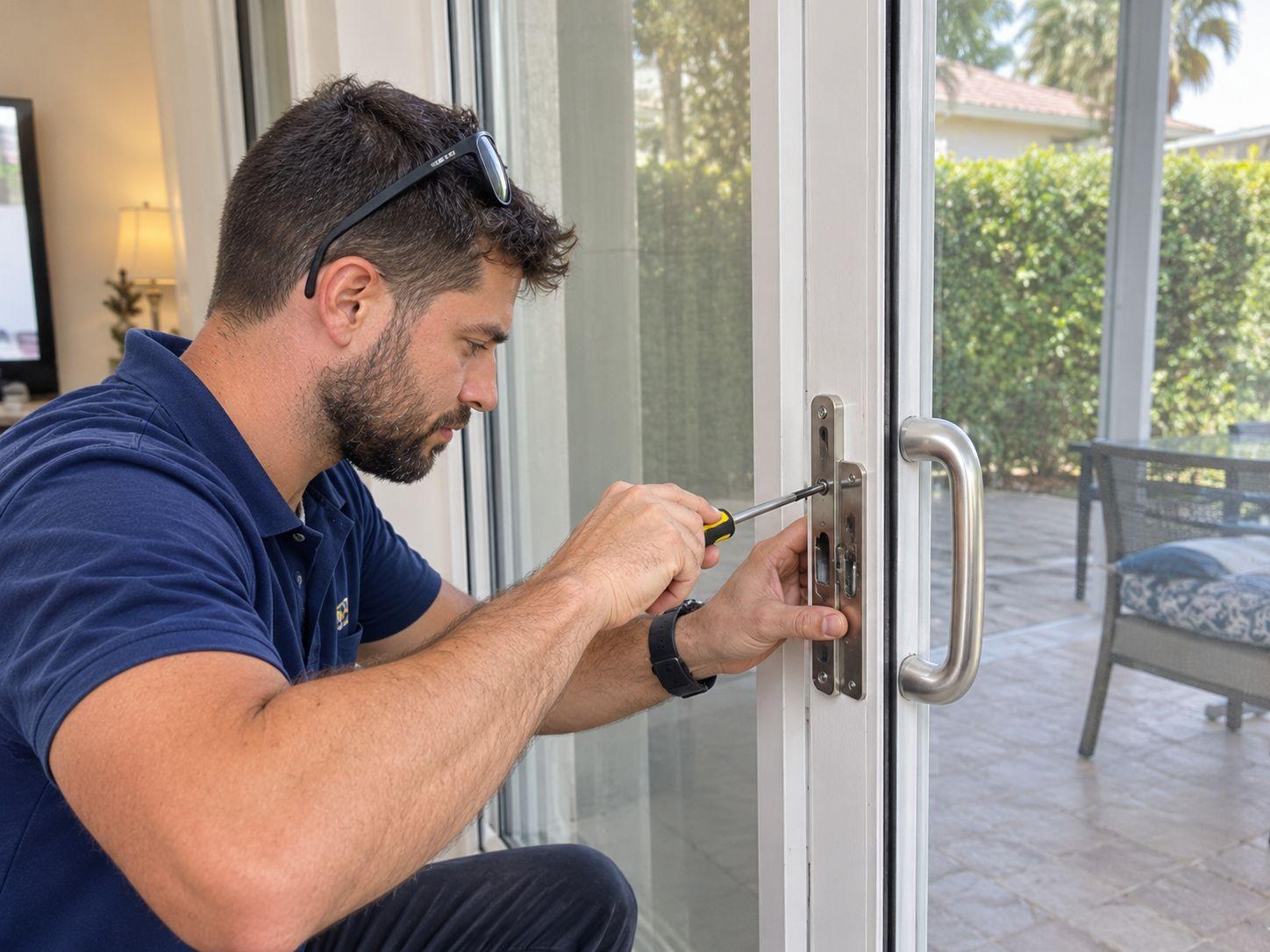
Replace the lock itself when the hook is bent or snapped, the lever inside the handle spins without moving the hook, or the latch is so loose it rattles. Those are worn parts, and no adjustment brings them back.
Mortise locks and surface-mount handles
Sliding door hardware comes in two basic layouts, and the replacement has to match the one you have.
With a mortise lock, the latch mechanism is a separate metal body that slides into a pocket cut into the edge of the panel, held by two screws through a faceplate. The handle on the face of the door carries only the lever that works it. With a surface-mount handle set, the hook is built into the handle itself and the whole assembly sits on the inside face.
The two parts work as a system. Retail listings for handle sets often note which lock types they're built for, and many mortise-style handle sets are sold without the lock body inside. A handle that fits your screw holes can still fail to work your lock if the lever and the keyway angle don't match.
Measure before you order
The single measurement that matters most for a handle is the distance between its mounting screws, center to center. Get that and the panel thickness right, and most of the guesswork is gone.
SECURITY LAYERS · XO
- 1The latch and keeper. Holds the door shut. It only works when the panel sits at the right height and the keeper lines up with the hook.
- 2Keyed cylinder (optional). Locks the latch from outside. Some non-keyed handle sets accept a conversion kit.
- 3Something in the track. A security bar, a screw-down track blocker or a cut dowel stops the panel from sliding even if the latch is beaten.
- 4Pin or foot lock. Pins the sliding panel to the fixed panel or the sill. A pin hole has to be placed clear of the glass and the latch.
- 5Anti-lift in the header. Screws or blocks in the top track, set so the door still slides but can't be lifted off its rollers.
- 6Rollers set correctly. A sagging panel is easier to lift out and makes the hook miss the keeper.
- 7Exit alarm on pool doors. One of the options in Florida's pool safety law: 85 dB A at 10 feet on doors that open to the pool.
Bedroom slider used as an escape route? Every layer on it should open from inside by hand, with no key or tool. Ask your local building department before adding a key-inside lock or a fixed bar.
MEASURING FOR NEW HARDWARE
Handle set
- Find the two screws that hold the inside handle on.
- Measure from the center of the top screw hole to the center of the bottom one. Not edge to edge, and not the handle's overall length.
- Compare with sizes sold as replacements: 3-15/16, 4-15/16, 5, 6-1/2 and 6-5/8 inches are common, and 3-1/2 exists.
- Measure the panel's thickness where the handle mounts and check it against the new set's listed range.
- Note whether the latch is a separate lock body in the door edge or built into the handle, and photograph the old parts.
Mortise lock body
- Remove the two screws on the edge of the sliding panel and slide the lock body out.
- Measure the faceplate's screw holes center to center. Listings show sizes such as 3-11/16, 3-7/8, 4-5/8 and 5-3/8 inches.
- Note the keyway angle (45 or 90 degrees when locked) and whether the faceplate ends are round or square.
- Take the old lock, or a photo with the measurements, when you buy the new one.
If your door is older or an unusual brand, take photos of both faces of the handle, the edge of the panel with the faceplate, and the keeper. A good parts counter can often match from photos when the measurements land between sizes.
The layers that actually secure a slider
A latch keeps the door closed. On its own it doesn't do much to keep someone out. Put plainly, sliding glass doors are secured by latches rather than locks, and many older sliders can be lifted up and off their track. Our Miami Gardens page goes through these layers for a city made up mostly of single-family houses.
Real security comes from adding layers that work even if the latch is beaten:
- A blocking device in the bottom track, such as a fold-down security bar, a screw-down track blocker, or a dowel cut to length
- Screws driven partway into the upper track above the sliding panel, or anti-lift blocks, so the panel can't be raised off its rollers
- A pin lock through both panels where they overlap
- Rollers adjusted so the panel isn't sagging, which the St. Petersburg police list as part of keeping a door from being lifted out
Anti-lift screws need care. Set them too low and the door binds against them every time it slides. They should leave just enough clearance for the panel to move freely.
For forced-entry ratings on a new door, ASTM F842 is the test method used for sliding door assemblies. If security is the main reason you're shopping, asking whether a door has been tested to it is a fair question, and it's one reason some owners move to a new door with a multipoint lock.
Pool homes and Florida's door alarm option
If a slider opens straight onto your pool area, Florida's pool safety law has something to say about it. The law requires a new residential pool to have at least one of five safety features before it passes final inspection. Two of them involve doors.
One is an exit alarm on every door and window with direct access to the pool, rated at least 85 dB A at 10 feet. The other is a self-closing, self-latching device on those doors, with its release at least 54 inches above the floor. Sliding glass doors don't close themselves, so the alarm is the route most slider owners see.
Whether and how this applies to your existing home is a question for your local building department. We won't give legal advice on it. What we can tell you is that an alarm sensor is another piece of hardware on the door, and it only works properly on a panel that closes fully and lines up.
Where we start on a lock that won't catch
We start with the panel height and the keeper position, because if that turns out to be the cause, the fix needs no new parts. Then we look at the hook, the lever and the lock body for wear, and check the handle's screw spacing and the panel thickness in case new hardware is needed.
If the door needs a lock, we match it to the handle and keyway rather than forcing a near fit. If you'd like extra layers, we'll go through which ones suit your door and how you use it.
Hinged patio doors and other hardware
French and other hinged patio doors use different locks altogether, often with bolts at the top and bottom of the panel. Those are covered with the rest of that door type on our patio door repair page. If the lock works but the whole door still sticks, binds or leaks, the general sliding glass door repair guide is the better place to start.
FAQ
Lock, latch and handle questions
Why won't my sliding door lock line up anymore?
Usually the panel has dropped. Worn or settled rollers lower the door, so the hook swings under the keeper instead of into it. Raise the panel with the roller screws, then slide the keeper up or down in its slotted holes.
How do I adjust the latch on a sliding glass door?
Close the door slowly and watch where the hook meets the keeper. Loosen the keeper's two screws, slide it to meet the hook, and tighten. Some mortise locks also have a screw on the faceplate that changes how far the hook reaches.
How do I measure a sliding door handle for replacement?
Measure the distance between the two mounting screw holes, center to center. Common sizes include 3-15/16, 4-15/16 and 6-5/8 inches. Also measure the panel thickness, since each handle set fits a limited range.
Are sliding door handles universal?
No. Handles vary in screw spacing, panel thickness range, and whether they work a separate mortise lock or have the hook built in. A handle that fits your holes can still fail to work your lock if the lever doesn't match.
What is a mortise lock on a sliding door?
It's the latch mechanism housed in a pocket cut into the edge of the sliding panel, held by two screws through a faceplate. The handle on the face only carries the lever that moves the hook in and out.
Can I add a keyed lock to my sliding door?
Often, yes. Some non-keyed handle sets accept a cylinder conversion kit, and others can be swapped for a keyed set with the same screw spacing. Check that the new set works with the lock body already in your door.
Can a locked sliding glass door be lifted off its track?
Many older ones can. A slider can be lifted up and out, defeating the latch. Anti-lift screws or blocks in the upper track and properly adjusted rollers prevent it.
Is a security bar or a dowel in the track better?
Both block the panel from sliding. A fold-down security bar mounts at mid-height, is easy to see from outside and swings out of the way when you need the door. A dowel works but is easy to forget and can be a trip hazard.
Does a sliding door to the pool need an alarm in Florida?
It's one of the options. For a new residential pool to pass final inspection, Florida law requires one of five safety features, and one is an 85 dB A exit alarm on doors with direct pool access. Ask your building department about your situation.
Why is my sliding door handle loose?
The through-screws holding the inside and outside halves together have backed out, or the screw holes in the panel have worn. Tighten them gently. If the handle still wobbles, the mounting bosses may be cracked and the set needs replacing.
Should I replace the lock and handle at the same time?
Not always. If only the handle is cracked and the lock body works, a matching handle is enough. When the lock is worn, replacing both together avoids mismatched levers and keyways, especially on older doors.
Send a photo of the handle, the edge of the panel and the keeper on the frame. We can usually tell from those whether it's a fit problem or a worn-out lock.