SHORT ANSWER
Sliding screen door repair covers the three parts that fail: torn or sun-brittle mesh, bent aluminum frames, and the small spring rollers that keep the screen on its track. A straight frame gets rescreened, often with a mesh suited to Florida bugs, pets or sun. Worn rollers get replaced, and badly bent frames get a new screen door.
Fix the frame, the rollers or the mesh
A sliding screen door has three parts that fail, and they fail for different reasons. The mesh tears or goes brittle in the sun. The thin aluminum frame bends when it gets bumped or leaned on. And the little rollers at the bottom wear out until the screen drags, wobbles or falls off its track.
Most screen problems are one of the three, and sorting out which tells you whether you need a patch, a rescreen, new rollers or a new screen door altogether.
Why the screen keeps coming off the track
When a homeowner tells us the screen keeps popping out at the bottom, it's almost always a roller problem. Screen rollers are small spring-loaded wheels, usually one or two at each bottom corner, and the spring pushes the wheel down so the screen stays snug between the top and bottom tracks. When a wheel cracks, a spring weakens, or the adjustment screw backs out, the screen loses that pressure and walks off the rail.
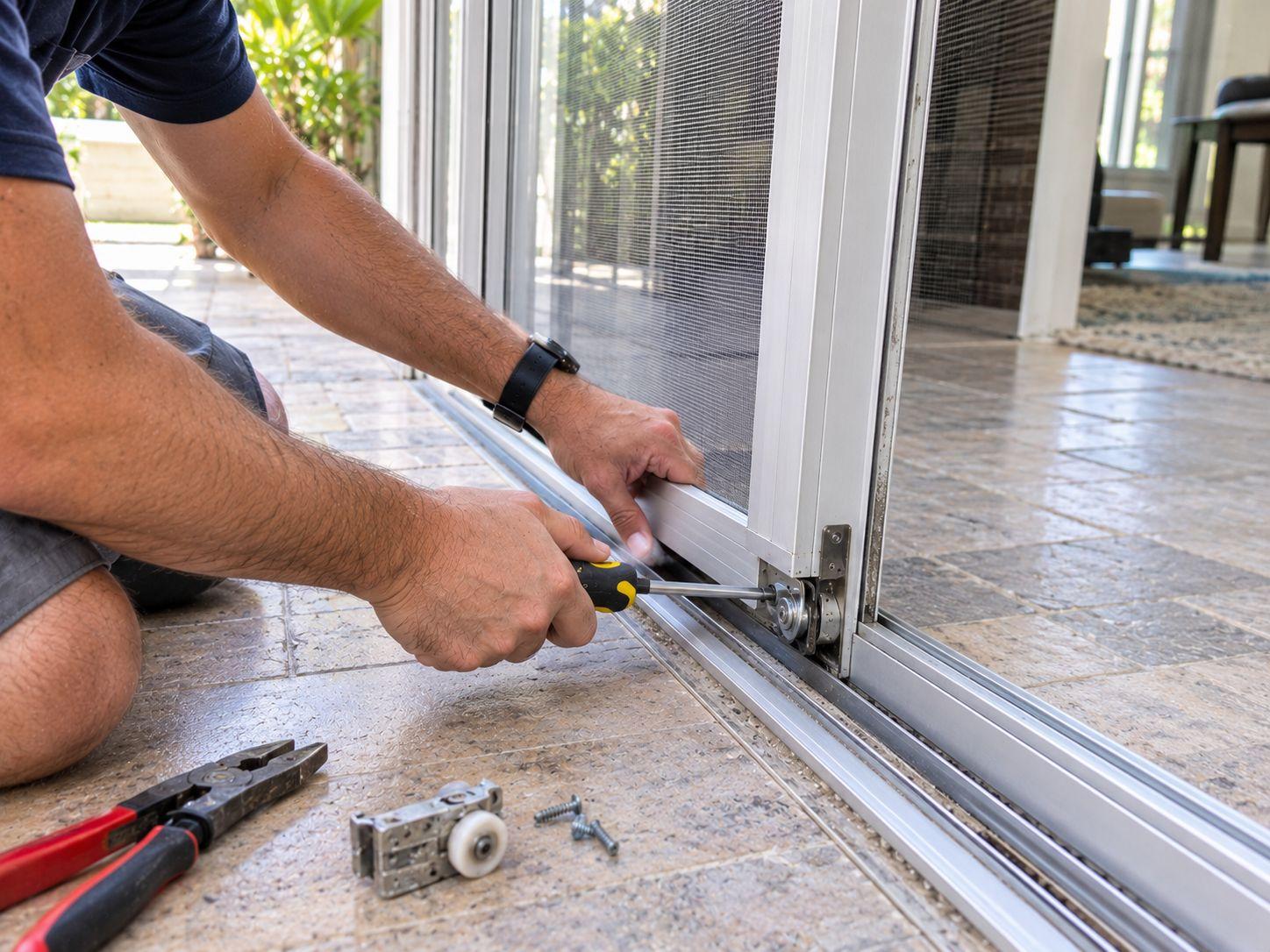
These aren't the same parts as the rollers under your glass door. They're smaller, lighter and sold separately, so measure the old ones (wheel diameter and housing size) before buying. If the glass panel is the one dragging, that's a heavier job covered on our roller replacement page.
A bent bottom rail on the screen frame does the same thing, and so does a dented screen track. Sight down the frame from one end. If it bows, the screen won't sit level no matter what the rollers do.
Patch, rescreen or replace?
Small, clean holes can take a patch kit. They're not pretty, but they keep bugs out.
Rescreening makes sense when the frame is straight and its corners are tight. The old mesh and spline (the rubber cord that holds the mesh in its groove) come out, new mesh is stretched across, and new spline is rolled in. If the mesh crumbles when you press it with a thumb, it's sun-damaged all over and patching won't last.
A new screen door is the better buy when the frame is bent, the corners have split, or the whole screen has been off the track so many times that the rails are chewed up. Rescreening a bent frame just gives you a tight new mesh on a door that still won't slide.
Choosing mesh for a Florida door
This is where Florida screens differ from screens anywhere else. The mesh you pick matters as much as the repair.
| Mesh | Weave (strands per inch) | Durability | Seeing out | Airflow | Best for | Typical spline |
|---|---|---|---|---|---|---|
| Standard fiberglass | 18 x 16 | Good | Good | Good | An everyday door screen | .140 in. |
| Pool and patio fiberglass | 18 x 14 | Better | Good | Good | Tall doors and big openings that need a heavier strand | .140 in. |
| No-see-um fiberglass | 20 x 20 | Not rated | Good, slightly reduced | Lower than standard | Tiny biting midges, at the cost of some breeze | .140 in. |
| Pet-resistant polyester | Heavier, coarser weave | Best | Good, slightly darker | Good | Dogs, cats and kids who push on the screen | One size smaller, often .125 in. |
| Solar screen (80% or 90%) | Tight polyester | Not rated | Lower: roughly 36 to 39% or 18 to 20% of light passes | Lower | West or south doors that bake in afternoon sun | One size smaller, often .125 in. |
| Aluminum | Varies | Good | Better | Good | Inland homes. Not a coastal pick | .125 in. |
For homes near salt water, fiberglass, sun control screens and the tougher pet-resistant meshes are the right picks. Aluminum mesh isn't. That advice covers a big share of our service area: Hollywood, Fort Lauderdale, Pompano Beach, Deerfield Beach and Boca Raton all sit on the ocean, and the humidity and salt reach well past the first few blocks.
No-see-ums need a straight answer. Fine 20 by 20 "no-see-um" mesh does stop most tiny insects. A University of Arizona extension sheet on biting midges notes they can get through standard 16 by 16 and 18 by 16 screen, and it suggests 30 by 30 mesh where you can manage it. A 20 by 20 screen is a real improvement over standard, but it isn't a wall, and it costs some breeze.
Solar screen is worth it on doors that face west or south. Solar mesh blocks 80 or 90 percent of the sun's heat and glare, depending on the grade. The trade-off is the view: the 90 percent version lets through only about a fifth of the visible light, so the screen reads as a dark panel from inside during the day.
Pet screen is a vinyl-coated polyester built to resist claws and paws. It's thicker than regular mesh, which matters at install time, because thicker mesh needs a thinner spline to fit the same groove.
Spline size, the detail that ruins rescreens
Spline comes in sizes measured in thousandths of an inch, and a mismatch is a common reason a DIY rescreen pulls loose or won't go in. Typical sizing is .140 inch spline for standard fiberglass in common grooves, .125 inch for aluminum mesh, and one size smaller for pet and solar screens.
The surest way to choose is to pull a piece of the old spline and match it, then go down a size if you're switching to a thicker mesh. To check what mesh you have now, cut a one-inch square out of paper, hold it against the screen and count the openings across and down.
Screen work, start to finish
We check the screen track and the rollers before touching the mesh, because a new screen on a bad rail won't stay put. Then we look at the frame: straight and square means rescreen, bent or split means a new frame.
If you want a different mesh, bring it up. Switching from standard to pet screen or solar screen happens at the same time as the rescreen. In an HOA community, check the color rules first: our Pembroke Pines page explains why screen color is often the association's call.
When the problem is the glass door behind it
The screen rides on the outer rail of the same sill as your glass door. If that rail is dented or packed with sand, the screen suffers first, and track repair fixes both. For anything else going on with the main door, start with our sliding glass door repair guide.
FAQ
Screen door questions
Why does my sliding screen door keep falling off the track?
Usually the small spring rollers at the bottom are worn, cracked or adjusted too high, so the screen loses its grip between the top and bottom tracks. A bent screen frame or a dented outer rail causes the same thing.
Is it worth rescreening a sliding screen door or should I buy a new one?
Rescreen it if the frame is straight and the corners are tight. Replace the screen door if the frame is bent, the corners have split, or the rails are chewed up from coming off the track.
Are screen door rollers the same as sliding glass door rollers?
No. Screen rollers are smaller, lighter spring-tension wheels made for a frame that weighs very little. Glass door rollers carry the full weight of the glass panel. Measure the old screen roller before buying a new one.
Can I patch a hole in a screen door instead of replacing the screen?
For a small, clean hole, yes. A patch kit keeps bugs out even if it shows. If the mesh is brittle and crumbles when pressed, it's sun-damaged all over, and a full rescreen is the only lasting fix.
What size spline do I need for my screen door?
Match a piece of the old spline. Typical sizing is .140 inch for standard fiberglass in common grooves and .125 inch for aluminum mesh. Go one size smaller when switching to thicker pet or solar screen.
Will no-see-um screen keep out no-see-ums completely?
Not completely. A 20 by 20 mesh stops far more than standard screen, but a University of Arizona extension sheet suggests 30 by 30 mesh where possible for biting midges. Expect fewer bites, not none.
What's the difference between 18x16 and 18x14 screen?
The numbers are strands per inch in each direction. 18 by 16 is the standard fiberglass mesh. 18 by 14 is a heavier pool and patio mesh with thicker strands, made for bigger openings.
What is the best screen for a house near the beach?
Fiberglass-based mesh. Fiberglass, sun control screens and tougher pet-resistant meshes all suit coastal areas. Aluminum mesh doesn't, since salt air works on bare metal.
Can I put solar screen on a sliding screen door?
Yes. Solar screen mesh is sold for door screens and blocks 80 or 90 percent of the sun's heat and glare. It also darkens the view a lot, so it suits doors in hard afternoon sun more than doors you look through all day.
How do I tell what mesh my current screen is?
Count the openings. Cut a one-inch square in a piece of paper, hold it against the screen, and count the openings across and down. Eighteen across and sixteen down means 18 by 16 standard mesh.
How do lizards and bugs get in around a sliding screen door?
Through gaps. Check the bottom of the screen frame, the edge where it meets the glass door, and the pile weatherstrip along the sides. A screen that sits crooked on worn rollers leaves a gap at one corner.
Tell us whether the screen is torn, bent or falling off the track, and what you'd like it to keep out. A photo of the bottom corner helps.